
Need help?
93% of Executives Say Their Customer Experience Is Broken. In My Experience, They’re Solving the Wrong Problem.
11th March 2026
Johann Diaz
A recent WSJ Intelligence study of 800 senior executives revealed something striking:
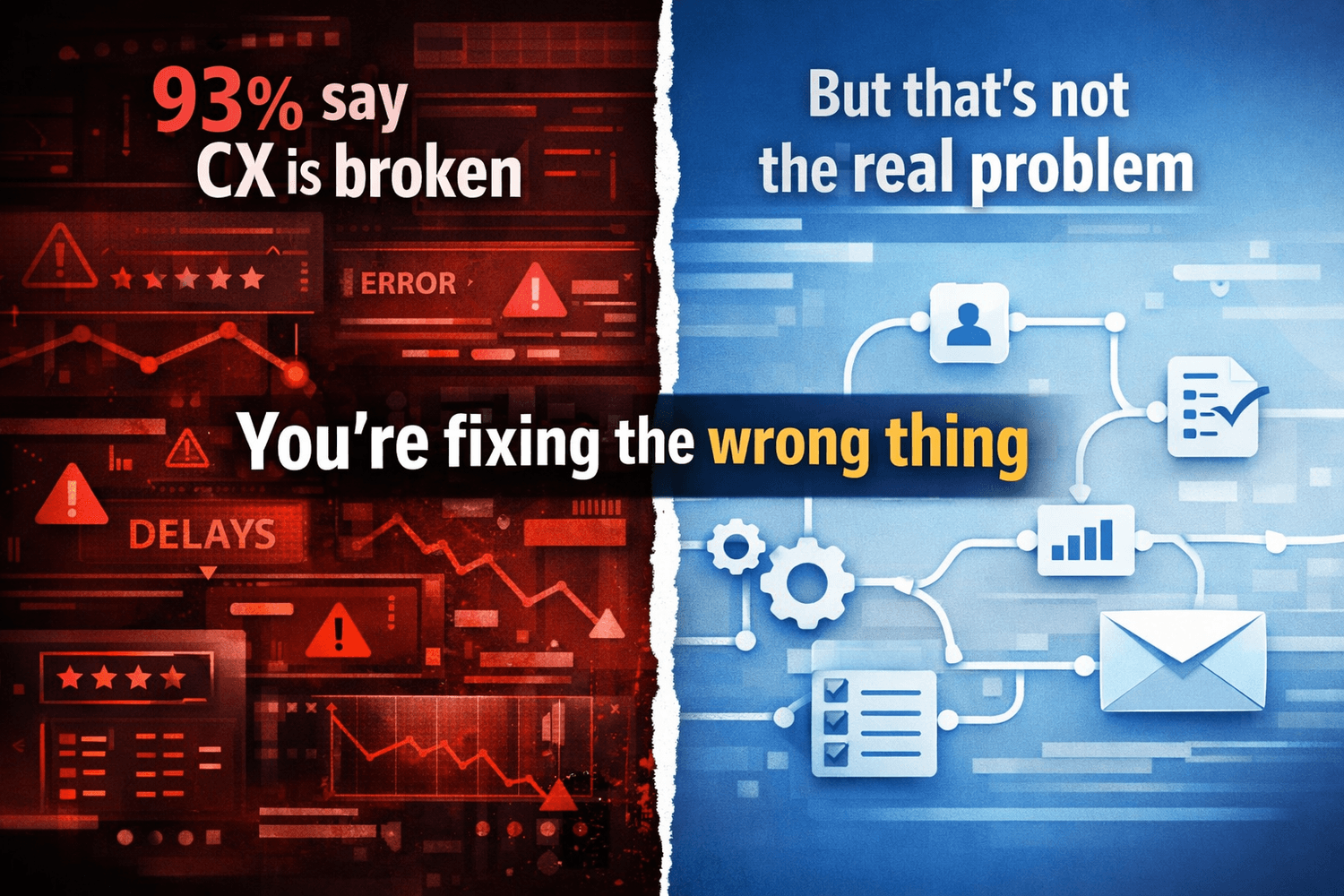
93% of C-suite leaders admit their customer experience is broken.
When almost every executive feels the same pain, it raises an important question:
Are organisations trying to fix the wrong problem?
The report suggests organisations should invest more in AI-driven emotional intelligence to better understand how customers feel.
That may help.
But after more than 35 years working in service operations and transformation, my view is that the real issue lies somewhere else entirely.
A Hard Truth About Customer Experience
One of the most important lessons I’ve learned over the years is this:
You cannot control how customers feel.
Two customers can receive exactly the same product, exactly the same service, from exactly the same organisation…
…and walk away with completely different experiences.
Why?
Because customer experience happens inside the customer’s mind.
Their mood.
Their expectations.
Their past experiences.
Their anxiety that day.
All of these act like a filter between what an organisation delivers and how the customer interprets it.
Which means something important.
There is a layer between service delivery and customer experience that organisations simply cannot control.
In my opinion, this is where many CX programmes begin to struggle.
What Organisations Actually Control
Over the years I’ve worked with organisations across industries — telecoms, energy, government, manufacturing and financial services — trying to improve service performance.
And what I’ve consistently observed is this:
The organisations that succeed do not obsess about designing emotions.
They focus on building reliable service operations.
Because these things are within organisational control:
• Product and service reliability
• Response speed
• Operational consistency
• Clear communication
• Recovery when things go wrong
• Joined-up processes across departments
These are the mechanics of service delivery.
And when these work reliably, positive experiences tend to follow naturally.
When they don’t, no amount of experience design will fix the outcome.
The Real Gap Emerging in Customer Experience
Recent research highlights another problem I see frequently inside organisations.
A report covered by CMSWire found that:
“Many organizations have made real progress in collecting customer insights, but far fewer have built the operational systems needed to act on them quickly.”
In other words:
Companies are getting better at listening to customers.
But they are far slower at fixing the underlying service problems.
In my experience, this is one of the biggest structural gaps in modern CX programmes.
Organisations have built impressive capabilities around:
• Customer feedback
• Surveys
• Sentiment analysis
• Voice-of-the-customer programmes
• Journey mapping
But when those insights reveal problems, the organisation often struggles to act.
Why?
Because the service system itself hasn’t been designed to respond effectively.
Something I Learned Early in My Career
Early in my career I was asked to help an organisation whose largest customer was threatening to cancel a major contract.
The product was good.
The leadership team cared deeply about the customer.
But internally the organisation was fragmented.
Engineering blamed manufacturing.
Manufacturing blamed design.
Installers blamed engineering.
Sales blamed support.
Finance continued invoicing the customer regardless.
And nobody owned the end-to-end service outcome.
In my opinion, that scenario still exists inside many organisations today.
Not because people don’t care.
But because the service architecture hasn’t been designed properly.
The Insight That Changed My Thinking
Over time I came to a simple conclusion:
Customer experience is not something organisations deliver.
It is something that emerges from the quality of service they operate.
When service operations are fragmented, inconsistent or siloed, the experience inevitably feels broken.
But when service operations are designed to be seamless, reliable and coordinated across the organisation, customers tend to have far better experiences.
Not because the company engineered their emotions.
But because the service simply worked.
Why Service Is the Real Strategic Lever
From what I’ve seen across industries, the organisations pulling ahead today are the ones shifting their focus from experience management to service architecture.
They invest in building:
• End-to-end service capability
• Joined-up operational processes
• Clear service accountability
• Integrated technology platforms
• Data-driven operational insight
This is exactly the thinking behind the Customer Service Revolutionizer (CSR) framework I developed through the Service Revolution Academy.
The framework focuses on designing the service system that enables organisations to deliver seamless, reliable outcomes across the entire enterprise — from marketing and sales through delivery, support and renewal.
Customer Service Revolutionizer…
Because in my experience, once service works properly, something interesting happens.
Customer experience problems begin to disappear.
A Different Question for Leaders
So when I see statistics like “93% of executives say their customer experience is broken”, I don’t immediately think the answer lies in better surveys or more sentiment analysis.
In my opinion the more important question is this:
Is your service operation actually designed to deliver the outcome your customers expect?
Because if the service system isn’t working, the experience never will.
My View After 35 Years in Service Transformation
After more than three decades working in this field, across organisations in both the public and private sectors, I’ve come to a very simple belief:
Great customer experiences are the by-product of great service operations.
Not the other way around.
And the organisations that truly understand this are the ones turning service into a powerful competitive advantage.
If this topic resonates with you, I’ve written more about the difference between experience thinking and service architecture thinking, and why it matters for organisations trying to grow through service.
And if you’re wrestling with this challenge inside your own organisation, feel free to reach out.
I’m always interested to hear what leaders are seeing in the real world.


Copyright 2025 | End to End Service.
End to End Service The Copse, Farnborough, Hampshire, GU14 0QD


