Need help?
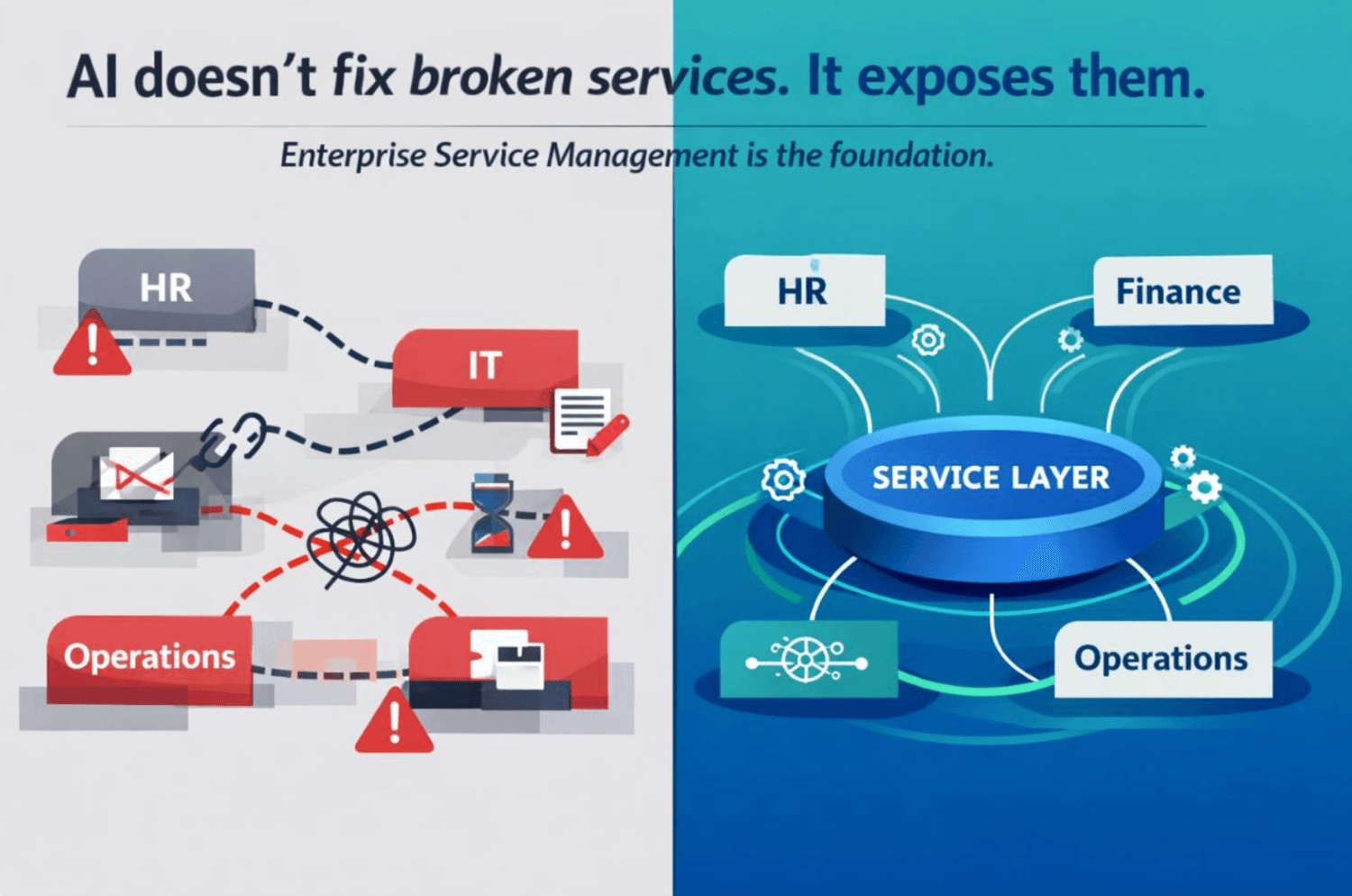
AI Doesn’t Fix Broken Services. It Exposes Them.
And right now, across far too many organisations, that exposure is uncomfortable
By Johann Diaz
I’m seeing leaders rush to deploy AI into HR, IT, customer service and operations—expecting speed, efficiency, and transformation—only to discover that automation hasn’t fixed anything. In many cases, it’s made things worse. Faster failures. Louder dysfunction. More visible cracks.
That surprise is understandable. For years, technology investments have been sold on the promise of simplification and scale. AI, in particular, has been positioned as a shortcut—an intelligent layer that could smooth over complexity, remove friction, and compensate for gaps in process or capability.
But AI doesn’t work around poor service design.
It doesn’t compensate for unclear ownership.
And it absolutely doesn’t tolerate fragmented workflows and messy data.
It shines a light on them.
What many organisations are experiencing right now isn’t an AI problem. It’s an organisational one. AI isn’t breaking services—it’s revealing how fragile they already were.
I’ve Seen This Movie Before—More Than Once
I recognise this pattern because I’ve lived through multiple waves of “this will fix everything” technology over nearly four decades.
I’ve run major global and local IT service management and service transformation programmes inside organisations such as Diageo, Vodafone, Unilever, BP, and Telefónica O2—often operating at scale, across borders, and under intense commercial and operational pressure. Later, as an advisor and consultant, I worked with organisations including HM Revenue & Customs, Transport for London, E.ON, and National Grid.
Different decades. Different industries. Different technologies.
The same underlying problem kept appearing.
Each wave of innovation arrived with genuine promise. Each was expected to simplify, standardise, and accelerate. And each time, the technology performed largely as designed. What struggled was the organisation around it.
IT Was Rarely the Issue. Services Were.
What became clear very early in my career was this: IT was almost never the root cause.
The real issue was that services had grown organically in silos—owned by individual functions, shaped by internal politics, constrained by legacy decisions, and optimised locally rather than end-to-end. Each team did what made sense for them at the time. Over years, those decisions hardened into structures that were difficult to see, let alone change.
Accountability blurred. Data fragmented. Handoffs became manual and fragile. Customers and employees felt the pain long before leaders saw it reflected on a dashboard.
In that environment, technology didn’t fail. It simply inherited the complexity it was dropped into.
IT Service Management was often the only part of the organisation trying to impose discipline—clear ownership, defined workflows, measurable outcomes. Meanwhile, everything around it continued to operate on goodwill, heroics, and informal workarounds.
Enterprise Service Management is what happens when that discipline finally escapes IT.
The Vendor Side Confirmed It
Later in my career, working inside enterprise software vendors such as ServiceNow, BMC Software,
and Serviceware, I saw the same story from the other side of the table.
Customers weren’t struggling because platforms lacked features.
They were struggling because their organisations weren’t structurally designed to scale service.
Tools can only amplify what already exists. If your services are fragmented, automation just
accelerates the chaos.
And now AI has arrived—and it’s stopped being polite.
AI Has Become a Brutally Honest Mirror
AI doesn’t tolerate ambiguity. It doesn’t guess who owns what. It doesn’t fill in the gaps between
HR, IT, Finance and Operations.
It exposes them.
Organisations trying to “layer AI on top” of broken services are discovering this the hard way.
Automation speeds up reality—it doesn’t improve it.
The organisations seeing real value from AI today are the ones that already treat service as an
enterprise capability. They’ve aligned workflows, data, accountability and outcomes before letting AI
loose. AI then becomes an accelerator, not a stress test.
This Is No Longer an IT Conversation
Here’s the shift leaders must grasp in 2026.
Enterprise Service Management is no longer an IT agenda item. It’s a CEO, COO and Chief Service
Officer conversation, because it directly affects:
Cost-to-serve
Employee productivity and experience
Speed of decision-making
AI scalability
Customer outcomes and trust
If organisations are trying to scale AI, transformation, or growth on top of siloed services, they’re building on sand. The instability may not show immediately, but it will surface—often at the worst possible moment.
The Question Leaders Must Answer Now
So, the question isn’t “Should we look at ESM?”
That decision has already been made by reality.
The real question is this:
Are you intentionally designing your organisation around service—or letting history, silos and
legacy decisions design it for you?
Across nearly forty years, I’ve seen both paths play out. One leads to clarity, scale and momentum.
The other leads to complexity, cost and permanent firefighting.
Enterprise Service Management isn’t the headline.
It’s the foundation.
And when AI is involved, foundations matter more than ever.
Copyright 2025 | End to End Service.
End to End Service The Copse, Farnborough, Hampshire, GU14 0QD


