
Need help?
Stop Obsessing Over CX. You Can’t Deliver Experience.
Experience is personal.
Service is controllable.
Johann Diaz - January 2026
Yet many organisations continue to blur the two, investing heavily in customer experience frameworks while quietly losing grip on the fundamentals of service delivery. Dashboards glow, journey maps multiply, and scores are tracked with scientific precision — but customers still leave frustrated, confused, or indifferent.
The uncomfortable truth is this: experience is not something an organisation can deliver. It is something a customer forms. Service, on the other hand, is designed, owned, and executed. When leaders confuse one for the other, they end up managing perception instead of performance — and that gap always shows.
Experience Lives in the Customer, Not the Organisation
Two people can sit in the same restaurant, order the same dish, and walk away with entirely different impressions. One remembers warmth and care. The other remembers delay and indifference. The environment was identical. The process was identical. Yet the experience was not.
That is because experience is shaped by expectation, emotion, context, and personal history. It is subjective by nature. No operating model, however refined, can guarantee how it will be felt.
This is where many CX strategies quietly overpromise. They imply that experience can be engineered, standardised, and delivered at scale. In reality, what can be delivered is service: how quickly someone responds, how clearly something is explained, how reliably a promise is kept, and how effectively a problem is resolved.
Experience emerges from those moments — but it does not belong to the organisation. It belongs to the customer.
The Danger of Managing What Cannot Be Controlled
Customer experience strategies often begin with good intent. They seek alignment, consistency, and empathy. But when experience becomes the primary object of management, something subtle and damaging occurs.
Leaders begin to optimise for how things look rather than how things work.
Self-service is a perfect example. Introduced as a way to improve convenience and empowerment, it frequently does the opposite when poorly designed. Customers do not experience “efficiency” when they reach a dead end. They experience abandonment. Each unresolved interaction weakens trust, not because the technology failed, but because ownership disappeared.
From an internal perspective, the journey may appear complete. From the customer’s perspective, it simply stopped.
This is where experience theatre begins: carefully designed journeys that look elegant on slides but collapse under real-world complexity. The problem is not the ambition to improve CX. It is the absence of service accountability beneath it.
What Customers Actually Respond To
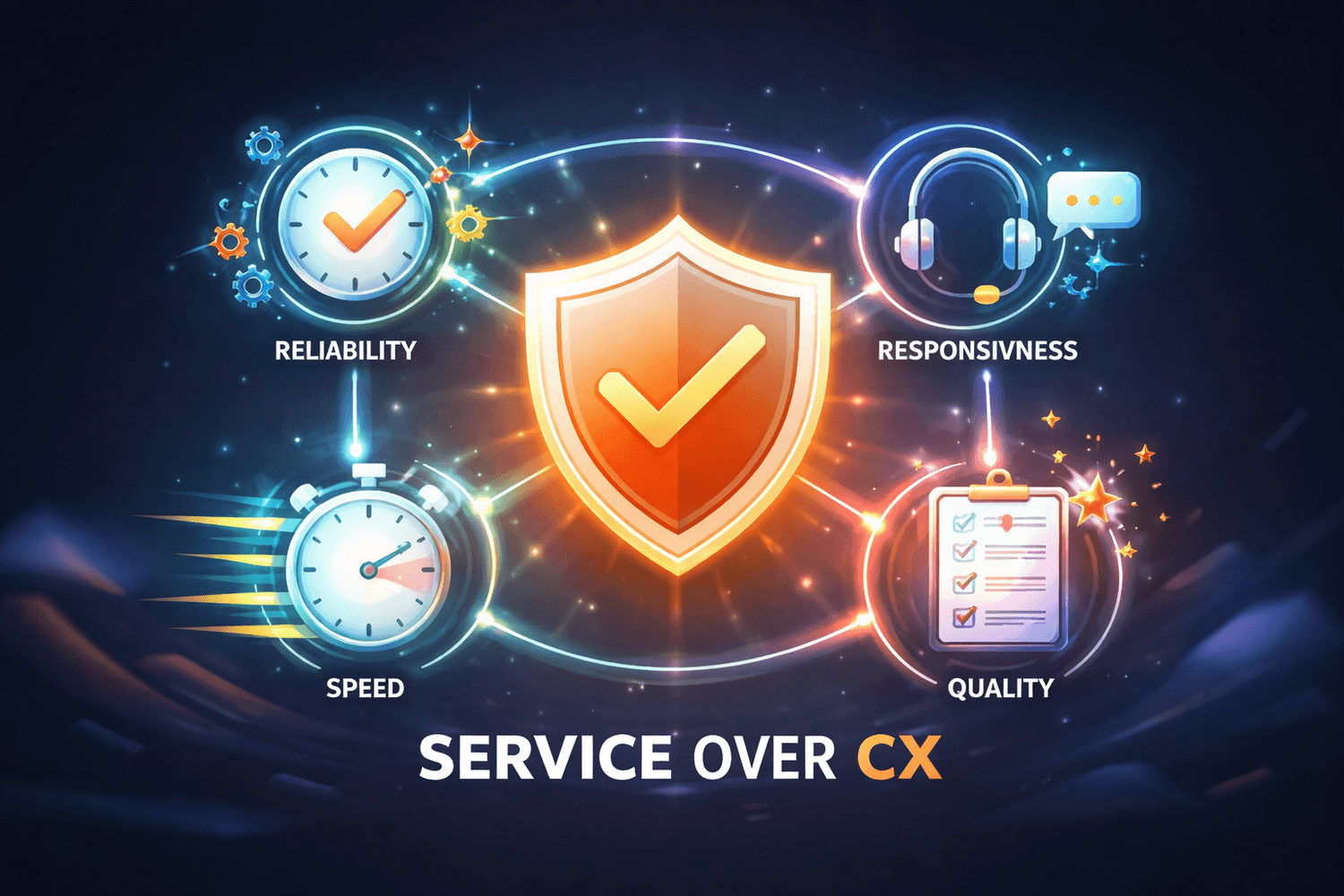
Across sectors — from logistics to telecoms, from contact centres to field service — the same pattern repeats. Customers consistently respond to a small set of signals:
•Speed
•Reliability
•Predictability
•Resolution
Delivery delays are not interpreted as operational issues; they are felt as broken promises. Long response times are not experienced as resourcing challenges; they are felt as disregard. Repetition is not seen as process complexity; it is experienced as fatigue.
In this context, speed becomes more than an efficiency metric. It becomes part of brand perception. Responsiveness becomes emotional, not transactional. Reliability becomes trust.
None of these outcomes are created by CX vision statements. They are produced by service design, decision rights, and operational discipline.
When Metrics Measure Activity Instead of Ownership
The modern enterprise is rich in metrics. Average handle time, service level, first contact resolution, customer satisfaction scores — all carefully tracked, reported, and debated.
Yet many of these measures tell leaders how busy the system is, not how accountable it is.
Customers do not experience averages. They experience outcomes. They remember whether an issue was resolved, whether they had to chase, and whether someone took responsibility end to end. A fast response that leads nowhere feels worse than a slower response that leads to clarity.
When CX metrics are disconnected from service ownership, they become performative. Numbers improve while trust erodes. Reports reassure while customers quietly disengage.
This is not a measurement problem. It is an ownership problem.
Tools Do Not Create Experience — Service Does
The market is crowded with tools promising to elevate customer experience: personalisation engines, surveys, quizzes, sentiment analysis, journey analytics. Each has value. None can compensate for weak service execution.
Personalisation without reliability amplifies disappointment. Insight without action deepens frustration. Data without authority creates awareness, not resolution.
Customers do not feel cared for because a system understands them. They feel cared for when someone acts on that understanding — quickly, clearly, and with authority.
Experience is not designed in isolation. It is remembered at the moment service either shows up or does not.
From Chief Experience to Chief Service Thinking
Perhaps the challenge is not customer experience itself, but how leadership frames responsibility.
Experience spans silos. Service crosses them.
Experience is measured after the fact. Service is delivered in the moment.
Experience reflects perception. Service reflects capability.
Organisations that mature beyond CX obsession begin to ask different questions. Not “How does this journey look?” but “Who owns the outcome when it breaks?” Not “What score did we achieve?” but “What friction did we remove?” Not “Did the customer rate us?” but “Did the service do what it promised?”
This shift does not diminish the importance of experience. It anchors it. When service is frictionless, responsive, and owned end to end, experience improves naturally — without being forced.
The Quiet Power of Service Discipline
There is nothing glamorous about service excellence. It lives in handovers, escalation paths, decision rights, and recovery processes. It requires clarity, not campaigns. Discipline, not declarations.
Yet it is precisely this unglamorous work that creates the conditions for positive experience. Customers may never see the service architecture behind the scenes, but they always feel the result.
The organisations that earn trust over time are rarely those with the most sophisticated CX language. They are the ones that show up consistently, resolve issues decisively, and take responsibility when things go wrong.
Experience, in those cases, is not delivered. It is earned.
A More Grounded Way Forward
Customer experience still matters. Deeply. But it should be treated as an outcome, not an object of control.
Service leaders who resist the temptation to manage perception — and instead commit to improving service quality, reliability, and responsiveness — create something far more durable than a high score. They create confidence.
And confidence, quietly and consistently, shapes experience far more powerfully than any framework ever could.


Copyright 2025 | End to End Service.
End to End Service The Copse, Farnborough, Hampshire, GU14 0QD


