Need help?
The AI Operating Model: Breaking Silos for Unified Service Lines.
An AI Operating Model breaks down departmental silos, unifying data and workflows to create a seamless customer experience.
Johann Diaz - February 2026
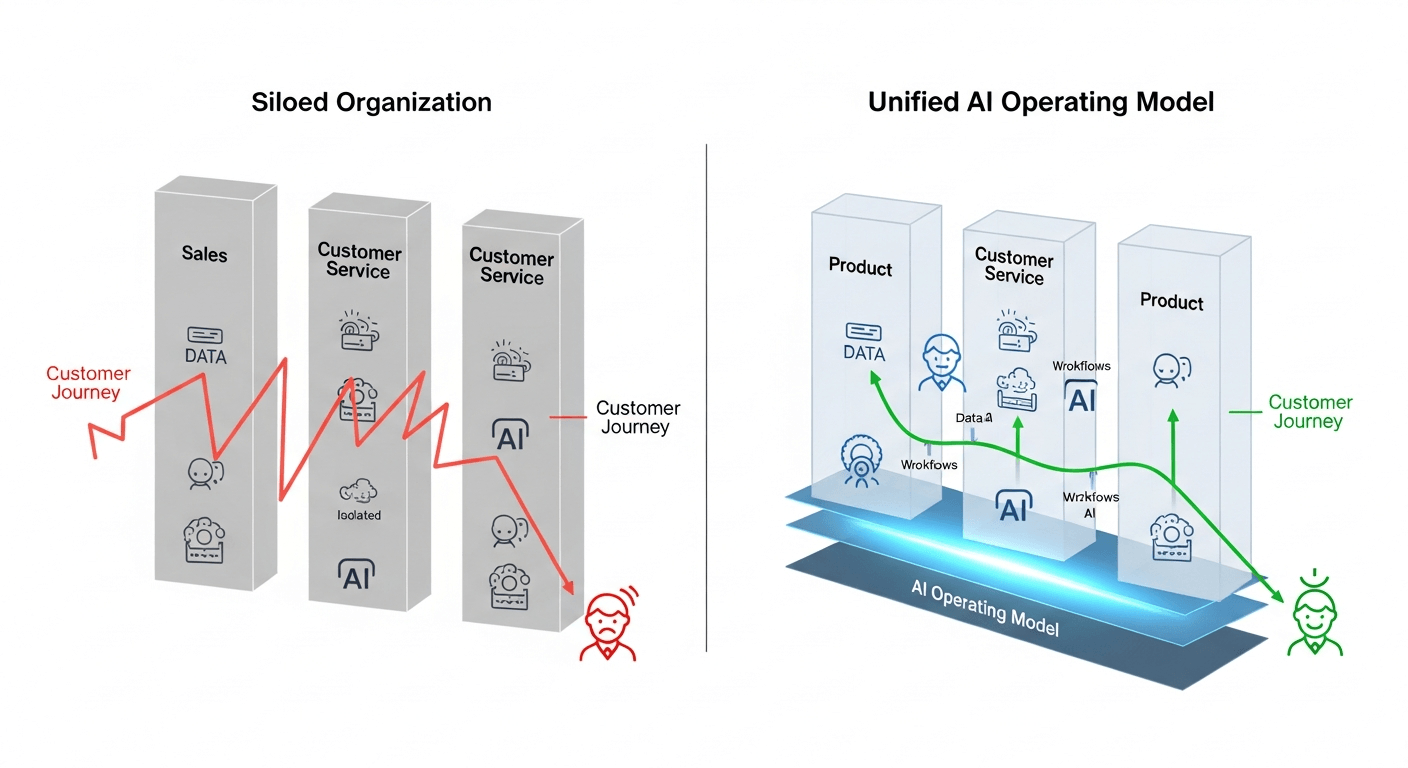
The rapid advancement of artificial intelligence presents an unprecedented opportunity for businesses to reimagine service delivery. Yet, despite the promise of AI-driven efficiencies and enhanced customer experiences, many organizations find themselves struggling to achieve meaningful scale. This stagnation often stems from a fundamental organizational challenge: entrenched silos. These departmental divides, where information is hoarded, workflows are disconnected, and decision-making processes are fragmented, create significant barriers to effective AI adoption. Without a unifying framework, AI initiatives often remain isolated experiments, failing to deliver on the transformative potential of artificial intelligence. This article explores how a strategic AI Operating Model can serve as the critical unifier, breaking down these silos to foster truly unified service lines and unlock a superior customer experience.
The Growing Imperative for Unified Service Delivery
Today's customer demands seamless, intuitive interactions across every touchpoint. They expect consistent, personalized support and a unified journey, whether they are engaging with sales, customer service, or product teams. The reality for many, however, is a disjointed experience dictated by the internal structures of the organization. Fragmented systems and processes mean that customer information is often incomplete or inaccessible across departments, leading to repetitive inquiries, frustrating delays, and a diminished overall customer experience. This breakdown in service delivery is no longer a mere inconvenience; it is a significant competitive disadvantage. As global adoption of generative artificial intelligence tools continues to surge, reaching 16.3 percent of the world's population in the second half of 2025, according to the AI Economy Institute, Microsoft, organizations that fail to provide a cohesive, AI-powered experience risk falling behind.
The AI paradox: unleashing potential, exacerbating silos
There is a paradox at the heart of many artificial intelligence initiatives. While AI promises to connect insight, accelerate decision-making, and elevate service performance, it can just as easily reinforce existing organisational divides when introduced without stratgic coherence. In many enterprises, AI tools are implemented by specialist teams within individual departments, often driven by local priorities rather than shared service outcomes. Over time, this well-intentioned activity creates new layers of fragmentation, this time embedded in technology rather than structure.
Without a unifying framework, AI initiatives risk becoming isolated “information islands”. Data, models, and insights remain confined within departmental boundaries, limiting their broader value. What begins as innovation gradually turns into complexity. This dynamic is frequently described as pilot paralysis, where organisations run multiple proofs of concept but struggle to translate early success into enterprise-wide capability. Adoption statistics illustrate the challenge clearly. While AI adoption across organisations has risen sharply, reaching 72 per cent after remaining closer to 50 per cent between 2020 and 2023, the ability to scale impact continues to lag. Industry research consistently shows that between 70 and 85 per cent of AI initiatives fail to meet their original objectives, not because the technology lacks potential, but because it is disconnected from a coherent strategy and unsupported by the right organisational foundations.
Introducing the AI Operating Model as the unifying force
Overcoming this challenge requires more than increased investment or more advanced tools. It demands a shift in how artificial intelligence is governed, integrated, and sustained across the organisation. This is where a strategic AI Operating Model becomes essential. Rather than functioning as a technical checklist, an effective AI Operating Model provides a comprehensive framework that orchestrates how AI supports service delivery at scale.
At its core, an AI Operating Model aligns technology, processes, and people around shared outcomes. It establishes consistent principles for data management, workflow integration, and decision-making, ensuring that intelligence moves across service lines rather than stopping at functional borders. By doing so, it reframes AI from a collection of isolated initiatives into a connected capability that strengthens enterprise-wide service performance. For organisations operating in increasingly intelligent and competitive service environments, this alignment is no longer optional. It forms the structural foundation for sustainable value creation.
The cost of disconnected systems and information islands
The operational cost of silos is pervasive and often underestimated. When departments function independently, information fragments by default. Data is captured in multiple systems, governed by inconsistent standards, and interpreted through narrow functional perspectives. Over time, this fragmentation solidifies into information islands, where valuable insight exists but remains inaccessible to those who need it most.
For artificial intelligence, this environment is particularly restrictive. AI depends on timely, high-quality, and well-contextualised data to deliver reliable outcomes. When information is scattered across disconnected platforms, the organisation loses the ability to create a single, coherent view of the customer. This limitation extends far beyond analytics. It shapes how service teams respond to issues, how products evolve, and how effectively the organisation can anticipate and adapt to changing customer needs. What should serve as a strategic advantage instead becomes a structural constraint.
How silos hinder AI adoption and business outcomes
Silos do more than slow progress. They actively undermine the effectiveness of artificial intelligence initiatives. Fragmented data landscapes make it difficult to collect, cleanse, and integrate the volumes of reliable data that AI systems require. As data quality deteriorates, confidence in AI-driven insight erodes, limiting adoption and diminishing impact.
Siloed operating models also encourage duplication. Teams develop overlapping or incompatible AI solutions, consuming resources while increasing complexity. Opportunities for reuse, learning, and scale are missed. Disconnected workflows compound the problem further. Insights generated in one part of the organisation cannot easily trigger action elsewhere, preventing end-to-end optimisation and disrupting the continuity of service delivery.
The outcome is predictable. Artificial intelligence remains confined to isolated use cases, delivering localised efficiency rather than enterprise-wide transformation. Instead of dissolving organisational boundaries, AI becomes constrained by them, reinforcing fragmentation rather than enabling truly unified service lines.
Defining the AI Operating Model (AIOM) for Strategic Unification
An AI Operating Model (AIOM) is a strategic framework that defines how an organization will leverage artificial intelligence across its entire enterprise. It goes beyond the technical implementation of AI tools to encompass people, processes, data, and governance, ensuring that AI is integrated seamlessly into business workflows and decision-making processes. The goal is to create a cohesive, scalable, and sustainable approach to AI transformation.
Beyond Technical Implementation: A Strategic Framework for Enterprise AI
An AIOM is fundamentally about strategy. It's about moving past the point solution mentality and viewing AI as a core enabler of business value. This means aligning AI efforts with overarching business goals, defining clear roles and responsibilities, and establishing mechanisms for continuous improvement. It requires a shift from project-based thinking to platform-based thinking, where AI capabilities are built and managed as services that can be leveraged across the organization. This strategic perspective is vital for breaking down silos and ensuring that AI drives meaningful transformation.
Shifting from "AI Pilots" to a Cohesive AI Strategy
The transition from experimental AI initiatives to a scaled, enterprise-wide AI strategy is a critical step. An AIOM provides the structure and governance necessary for this leap. It ensures that successful AI pilots are systematically integrated into production environments, that lessons learned are applied across the organization, and that new AI solutions are developed with interoperability and scalability in mind. This fosters a cohesive approach, maximizing the return on AI investments and ensuring that AI capabilities are consistently applied to solve pressing business problems and enhance customer service.
The "Outcome-First AI Target Operating Model" Philosophy
A core tenet of a successful AIOM is the "Outcome-First" philosophy. This means prioritizing the desired business outcomes – such as improved customer experience, increased operational efficiency, or enhanced decision-making – over the specific AI technology being deployed. An AIOM built on this principle ensures that every AI initiative is tied to measurable business value. It guides the selection of AI use cases, the allocation of resources, and the definition of success metrics, ensuring that AI adoption directly contributes to strategic goals and delivers tangible benefits to the customer and the business. This philosophy helps to address the common pitfall of technology-driven projects that lack clear business alignment.
Core Pillars of an AIOM for Breaking Silos and Unifying Service Lines
To effectively break down silos and unify service lines, an AIOM must be built upon several interconnected pillars. These pillars provide the architectural and organizational foundation for integrated AI capabilities.
Pillar 1: Unified Data Architecture and Management
At the heart of any AI initiative is data. To unify service lines and break down silos, organizations must establish a unified data architecture. This involves breaking down data silos, ensuring data quality, and creating a single, accessible source of truth. When information is integrated and reliable, AI models can be trained more effectively, leading to more accurate insights and better decision-making. This foundational pillar is critical for enabling seamless data flow across different business functions, from product development to support. Addressing the 81% of business leaders who say data silos hinder their AI transformation efforts, according to Zapier, 2026, is paramount.
Pillar 2: Integrated AI Workflows and Automation
An AIOM must foster integration of AI capabilities into existing and new workflows. This pillar focuses on connecting disparate systems and automating end-to-end processes. By integrating AI-powered automation, organizations can streamline operations, reduce manual effort, and accelerate decision-making. For example, integrating AI into customer service workflows can enable intelligent routing of inquiries, automated responses, and proactive issue resolution, significantly enhancing customer experience. Similarly, integrating AI into product development can refine design based on real-time market feedback and support data.
Pillar 3: Empowering Cross-Functional AI Teams and Talent
Effective AI transformation requires a shift in organizational structure and talent development. This pillar emphasizes empowering cross-functional teams that bring together expertise from various departments, such as IT, data science, operations, and business units. Fostering collaboration and developing AI literacy across the organization is crucial. This also involves addressing the global AI skills gap, which costs businesses $5.5 trillion in lost productivity, according to Iternal, 2026. Cross-functional teams ensure that AI solutions are developed with a holistic understanding of business needs and can be effectively integrated across service lines.
Pillar 4: Robust AI Governance and Ethical Frameworks for Cohesion
As AI becomes more pervasive, robust governance and ethical frameworks are essential for maintaining cohesion and trust. This pillar ensures that AI is developed and deployed responsibly, addressing issues of bias, fairness, privacy, and compliance. Clear policies and oversight mechanisms prevent AI from creating unintended negative consequences and ensure that it aligns with organizational values. Effective governance also helps to manage risks associated with AI, ensuring that AI adoption proceeds in a controlled and ethical manner, thereby supporting unified and trustworthy service delivery.
Pillar 5: Scalable AI Platforms and Cloud-Native Infrastructure
Underpinning all AI efforts is the need for scalable platforms and modern, cloud-native infrastructure. This pillar provides the technical foundation that enables integration, automation, and agility. A robust infrastructure supports the deployment, management, and scaling of AI models and applications across the enterprise. Cloud-native architectures offer the flexibility and scalability required to handle increasing data volumes and computational demands, ensuring that AI capabilities can evolve with business needs and support a unified approach to product and service delivery.
Implementing the Unified AI Operating Model: Practical Strategies
Implementing an AIOM requires a structured, phased approach that focuses on both strategic alignment and practical execution.
From Fragmented Initiatives to a Cohesive AI Portfolio Management
A key step in implementation is transitioning from managing individual, fragmented AI initiatives to establishing a cohesive AI portfolio. This involves creating a centralized system for prioritizing, tracking, and managing all AI projects, ensuring alignment with the AIOM's strategic objectives. Portfolio management helps to identify synergies between initiatives, allocate resources effectively, and avoid duplication of effort, thereby maximizing the impact of AI across the organization and supporting the unification of service lines.
Creating the "AI Front Door": A Unified Experience
A powerful manifestation of a unified AIOM is the creation of an "AI Front Door." This concept represents a single, intuitive point of access for customers and internal users to interact with AI-powered services and information. Whether it's a unified customer portal, an intelligent chatbot, or an internal knowledge management system, the AI Front Door consolidates capabilities, simplifies access, and provides a consistent, high-quality experience. This strategy directly addresses the customer's need for seamless interaction and reinforces the benefits of a unified approach to customer service and support.
Measuring the Success of a Unified AI Operating Model
Measuring the success of an AIOM requires looking beyond traditional metrics to focus on unified business value and the impact on customer experience.
Beyond Traditional Metrics: Focusing on Unified Business Value
While efficiency gains and cost reductions are important, the ultimate success of an AIOM is measured by its contribution to broader business objectives. This includes improvements in customer satisfaction, increased revenue, faster time-to-market for new products, and enhanced decision-making across the enterprise. Two-thirds (66%) of organizations report improved productivity and efficiency as a result of AI adoption, according to Deloitte US, 2026, but a truly unified AIOM aims for even greater strategic impact. Measuring the impact on customer service interactions and overall customer experience is critical.
Establishing Feedback Loops for Continuous Improvement and Adaptation
An effective AIOM is not static; it is designed for continuous improvement. Establishing robust feedback loops from customers, employees, and AI performance monitoring is essential. These loops provide valuable information for refining AI models, optimizing workflows, and adapting the operating model to evolving business needs and technological advancements. This iterative process ensures that the AIOM remains relevant and continues to drive value and unification across service lines.
Overcoming Challenges and Ensuring Sustainable Unification
Implementing an AIOM is not without its challenges, but these can be overcome with strategic planning and organizational commitment.
Navigating Organizational Change and Resistance
Significant organizational transformation often encounters resistance. Navigating these changes requires strong leadership, clear communication about the benefits of unification, and active stakeholder engagement. Training and upskilling employees to work within the new AI-driven environment is also crucial. Addressing concerns and fostering a culture that embraces collaboration over siloed ownership is key to sustainable transformation.
Addressing Data Quality and Legacy System Integration Hurdles
Poor data quality remains a persistent challenge for AI adoption, as highlighted by the fact that 81% of business leaders cite data silos as a hindrance to AI transformation, according to Zapier, 2026. Integrating AI with legacy systems also presents technical hurdles. Overcoming these requires a dedicated focus on data management, data cleansing initiatives, and strategic investments in modernization or middleware solutions to enable seamless integration.
Maintaining AI Governance in a Rapidly Evolving Landscape
The field of artificial intelligence is constantly evolving, posing a challenge to maintaining consistent governance. The AIOM must include mechanisms for regularly reviewing and updating governance policies and ethical guidelines to keep pace with new AI capabilities and potential risks. This ensures that AI continues to be deployed responsibly and ethically, supporting unified and trustworthy service delivery.
Fostering a Culture of Collaboration Over Siloed Ownership
Ultimately, the success of an AIOM hinges on fostering a culture of collaboration. Breaking down the deep-seated tendencies of siloed ownership requires a conscious effort to promote shared goals, cross-functional teamwork, and open communication. When departments work together towards a common vision of unified, AI-powered service lines, the true potential of artificial intelligence can be unleashed.
Conclusion: The Future is Unified – And AI-Powered
The era of fragmented operations and siloed service lines is drawing to a close. As artificial intelligence continues its rapid integration into the business landscape, organizations must embrace a strategic AI Operating Model to unlock its full potential. This model is the essential unifier, breaking down silos, integrating workflows, and centralizing information to deliver a seamless and superior customer experience. By adopting an "Outcome-First" philosophy, establishing robust pillars for data management, automation, talent development, governance, and scalable infrastructure, businesses can pave the way for a truly unified, AI-driven enterprise. The journey requires a commitment to transformation, a willingness to address ingrained challenges, and a clear vision for the future.
Reaping the Benefits of an AI-Driven, Unified Enterprise
Embracing the AIOM is not just about adopting new technology; it's about fundamentally rethinking how an organization operates to serve its customers better. It's about leveraging artificial intelligence to create intelligent, agile workflows, enable smarter decision-making, and deliver unparalleled customer service. By dismantling silos and fostering collaboration, businesses can achieve greater efficiency, drive innovation in product development, and build lasting customer loyalty. The future of successful business operations is undeniably unified, and that unification is powered by a well-defined and strategically executed AI Operating Model.


Copyright 2025 | End to End Service.
End to End Service The Copse, Farnborough, Hampshire, GU14 0QD


