Need help?
The Hidden Gap Between What You Promise and What You Can Fulfil
August 2026
Johann Diaz
SERVICE REVOLUTION ACADEMY | THOUGHT LEADERSHIP
SERVICEGAP
The Hidden Gap Between What You
Promise and What You Can Fulfil
How fragmented Service creates broken promises, wasted effort and lost
business value
By Johann Diaz | Founder, Service Revolution Academy
Most organisations spend a considerable amount of time and money on serving customers.
But before going any further, let me define what I mean by the term ‘Service’.
For me, Service is how an organisation understands needs, makes and fulfils promises, and
enables valuable customer and business outcomes.
That definition matters because Service is still too often treated as a department: the contact centre,
service desk, customer success team or group of people who step in when something goes wrong.
Service is much bigger than that. It includes what an organisation promises, what it sells, how it
fulfils those promises and whether the customer achieves the expected outcome.
Most organisations therefore spend heavily on Service, whether they recognise it or not. They
employ customer service, customer success, field service, IT service, operations and transformation
teams. They invest in CRM, IT and Enterprise Service Management platforms, workflow engines,
contact-centre technology, automation and increasingly, AI.
There is certainly no shortage of activity.
Yet many senior leaders still cannot answer a simple question: What measurable customer
and business value is all this service effort creating?
That is one of the questions at the heart of ServiceGap.
The ServiceGap is bigger than a performance shortfall
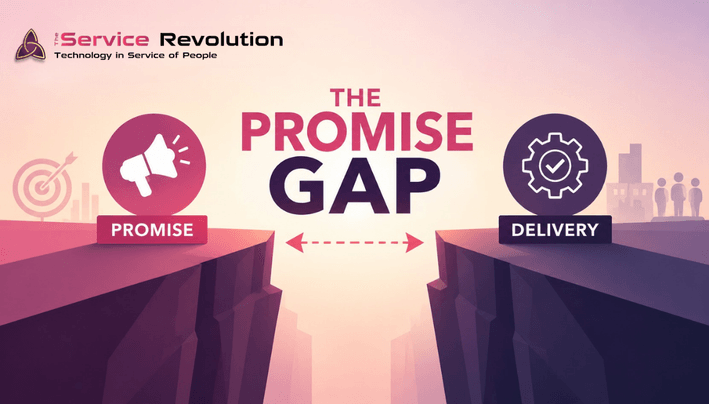
The ServiceGap is the difference between what an organisation promises and what it is consistently able to fulfil.
It can appear as the gap between:
customer promise and service reality;
intended experience and actual experience;
what leaders believe is happening and what customers actually receive;
organisational activity and customer outcomes, or
internal investment and realised customer value.
In some organisations, the gap is relatively small. Leadership, accountability, people, processes,
technology, data and knowledge are connected. Service promises are fulfilled without unnecessary
effort or confusion.
In many others, Service is fragmented across functions, teams, systems, channels, suppliers and
management structures. Each team may appear to perform reasonably well when measured
separately, while the end-to-end Service continues to fail.
That is where value disappears. Revenue is lost. Costs increase. Employees compensate for
broken processes. Customers repeat themselves. Technology investments underperform.
Transformation programmes deliver outputs without creating lasting capability.
And now AI is being applied on top of it all.
AI did not create the problem
Over more than 35 years working across service, operations, consulting, technology and
organisational transformation functions and programmes, I have lived through more waves of
technological change than I care to count. I have watched organisations adopt personal computing,
mobile technology, enterprise software, the internet, cloud platforms, automation, IoT and now
artificial intelligence.
Every wave has brought genuine opportunity. Every wave has also brought the dangerous
assumption that new technology will resolve organisational problems the previous technology failed
to fix. It rarely does.
AI has not created fragmented ownership, disconnected processes, inconsistent data or poor
accountability. Those weaknesses have existed for decades. AI is simply making them harder to
ignore.
I learned this early in my career when customers were being let down because engineering, product
development, manufacturing, sales, installation, technical support and finance were operating
separately. Each team could explain what it had done. But nobody owned the end-to-end result.
Years later, whether leading national service operations, designing multinational transformation
programmes or developing agentic AI prototypes, I have continued to see the same underlying
pattern.
People often act as the sticking plaster holding a fragmented service system together. They move
information between systems, chase other departments, correct inaccurate data and find unofficial
ways to get things done. Those workarounds, whilst once laudable, are largely invisible to senior
management because they sit between formal processes, systems and reporting structures.
AI can remove some of that human compensation and so it will also expose the true condition of the
underlying system.
AI does not repair a broken Service Model. It exposes it — and, if badly
applied, scales it.
An inefficient process remains inefficient when automated. A fragmented customer journey becomes
fragmented at greater speed. Weak accountability becomes automated confusion.
The biggest barrier to AI success is the fragmented organisation surrounding it.
Most organisations have service functions, not a Service Model
Most organisations have plenty of service teams. That is not the same as having a joined-up Service
Model.
A Service Model is the integrated design of an organisation’s Service Architecture, Service Portfolio and Service Operations, which collectively create the capability to consistently fulfil
service promises and enable desired customer and business outcomes.
Its three components each perform a distinct role.
Service Architecture defines how Service is structured, governed and owned. It includes such
things as leadership, accountability, organisational design, governance, culture, resources,
suppliers, partners and stakeholder relationships.
The Service Portfolio defines which Services the organisation offers, manages and improves, who
they are for, the needs they address and the outcomes they should enable.
Service Operations is the integrated system of people, processes, technology, data and knowledge
through which an organisation consistently fulfils its service promises.
Together, these components create Service Capability. But capability alone does not create
outcomes. It must be applied and operated consistently.
Need → Promise → Capability → Execution → Outcome → Value
This distinction is important. A completed workflow is not necessarily a fulfilled promise. A closed
case is not necessarily a resolved problem. And a resolved problem does not necessarily mean the
customer achieved the outcome they needed.
Customers do not experience Service Architecture, the Service Portfolio and Service Operations
separately. Nor do they care which department owns a system or which executive holds the budget.
They experience the combined result.
Over the last 35 years, I have watched IT Service, Customer Service, Field Service, Customer
Success, Operations and other wrap-around service capability for HR, Finance, Legal, Facilities and
other corporate business functions, gradually converge into one connected service ecosystem.
Everything is converging. The Service Model must therefore be designed and managed end to end.
Fragmentation has a commercial cost
Fragmentation is far more than an internal operational inconvenience. It affects revenue, margin,
retention, productivity, resilience and the ability to exploit technology effectively.
Consider what happens when a customer request crosses several functions. One team records it.
Another verifies it. A third approves it. Someone else fulfils it. Finance handles the transaction.
Technology supports the systems. A supplier may deliver part of the promised outcome.
Every hand-off creates the possibility of delay, duplication, information loss or confused
accountability. Each function may still meet its own target while the customer is let down.
Conventional cost management asks how much each department spends. Service-led cost
management asks what it costs, end to end, to fulfil a need and keep a promise.
That question often reveals repeat contact, rework, failure demand, duplicated data, unnecessary
approvals and employees compensating for badly designed work.
However, the objective is not simply to make people work harder or even more efficiently. Nor is it
simply to remove people from individual departments. But it should be to design out work that
should not need to happen or be needed in the first place.
Four areas every leadership team should examine
ServiceGap was developed to help senior leaders see where fragmentation and value leakage may
exist. The executive diagnostic asks 20 questions across four connected areas.
Leadership and Accountability
Does anyone genuinely own fulfilment of the service promise and the resulting customer and
business outcomes from end to end? Or does accountability stop at the edge of each function?
Customer and Experience
Does the organisation properly understand customer needs and the promises it makes? Is the
intended Service designed around those needs, or around internal structures and functional
convenience? Experience is formed in the mind and emotions of the customer. It cannot be repaired
with a better survey or journey map if the underlying Service remains broken.
Operational Efficiency and Process
Where is effort being consumed without fulfilling a promise or creating customer and business
value? Operational efficiency is not only about making each silo faster. It is about improving the end-
to-end flow of Service across the organisation.
Technology and AI Readiness
Is technology enabling a deliberately designed Service Model, or quietly defining it? Technology
must remain in service of people. It should help fulfil promises and improve outcomes — not
become the Service Model by default.
From +AI to AI+
There is an important difference between adding AI to an existing organisation and designing an AI-
enabled organisation.
I describe this as the difference between +AI and AI+.
+AI means bolting an agent, chatbot or automation tool onto fragmented processes, disconnected
systems and unclear accountability.
The organisation keeps the existing mess, but some of it now
operates at machine speed.
AI+ begins with the need, the promise and the outcome. It examines the Service Model and then
applies AI where it can genuinely improve fulfilment and create value.
+AI automates the organisation you already have.
AI+ helps create the organisation you actually need.
This is why AI readiness is really Service Model readiness. Who owns the service promise?
What knowledge will the AI systems and apps use? What actions can it take?
Where does accountability
sit? When must a human become involved? What happens when fulfilment fails?
These are not simply technology questions. They are Service Model questions.
Diagnose before you automate
ServiceGap is not intended to produce another impressive-looking score that is filed away and
forgotten. It is an executive diagnostic designed to start a better conversation.
Its purpose is to identify where fragmented ownership, weak Service Architecture, gaps in the
Service Portfolio, operational drag and disconnected technology may be preventing the organisation
from consistently fulfilling its promises and converting effort into customer and business value.
It does not pretend that 20 questions can uncover every root cause inside a complex organisation.
Nor is it a substitute for a detailed audit. What it can do is indicate where the most material gaps and
risks may exist, where leadership assumptions may differ from service reality and where deeper
attention should begin.
Organisations frequently launch transformation programmes before reaching a shared
understanding of the problem they are trying to solve. Technology is selected, workstreams are
created and activity begins. Months later, the organisation has implemented new tools while
preserving much of the fragmentation with which it started.
ServiceGap creates a deliberate pause before that happens. It asks leaders to look across the
organisation rather than down through individual functions. It exposes the spaces between
promises, teams, systems and accountabilities — where many Service failures originate.
Find out what your organisation is really capable of fulfilling
Your organisation may not be broken. It may simply be operating exactly as it has been designed to
operate.
If that design is fragmented, inconsistent outcomes are not surprising. They are the predictable
result.
If that’s the case, the answer is not another isolated customer service or customer experience
initiative, another departmental efficiency target or another layer of technology. It begins by seeing
the organisation as one connected service system and asking:
How capable is our current Service Model of consistently fulfilling our
promises and enabling the customer and business outcomes we expect?
That is what ServiceGap is designed to reveal.
Before you automate more work, invest in another platform or ask AI to operate across customer
and internal services, find out what it will be working with — and what it may end up scaling.
Diagnose before you automate.
Take the serviceGap Executive Diagnostic at ServiceGap.ai
Because, ultimately, It's All About Service.
AI ASSISTANCE DISCLOSURE
This article reflects the expertise, intellectual property and editorial oversight of Johann Diaz and the Service Revolution Academy.
Copyright 2025 | End to End Service.
167-169 Great Portland Street, Fifth Floor, London, W1W 5PF


